Stocks vs Bonds in Pakistan: Which Investment Is Right for You?
When it comes to growing your money, you've probably heard the terms stocks and bonds many times. Whether you're chatting with friends about money, reading financial news, or planning for your future, these terms often come up. But what do they actually mean, and more importantly, how do they fit into your everyday life and financial goals?
Understanding the Basics: Stocks and Bonds Explained Before diving into the complexities of the Pakistan Stock Exchange (PSX) and fixed-income instruments, it's essential to understand the fundamental concepts that drive these investment vehicles.
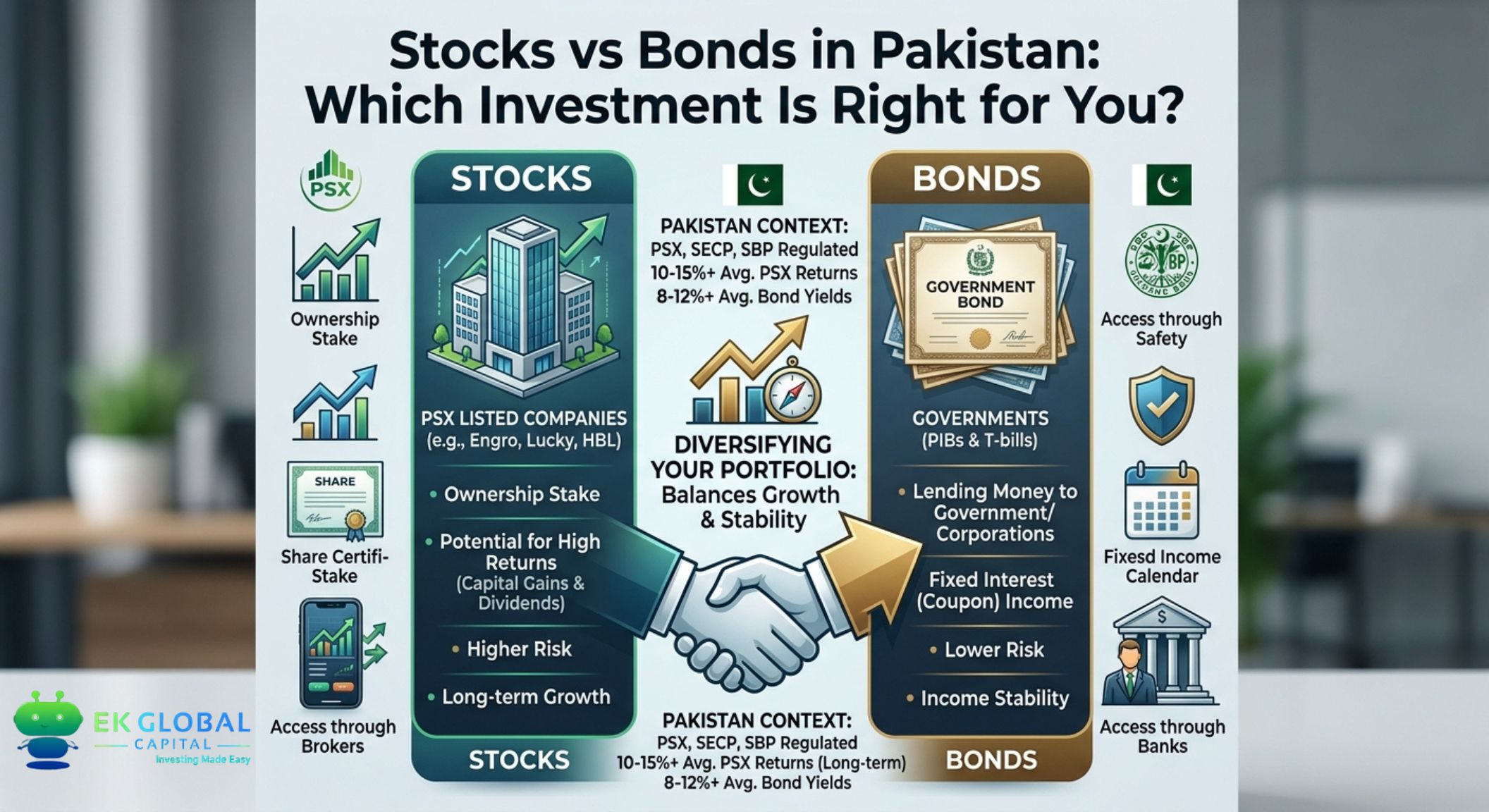
What Are Stocks (Shares)? When you buy a stock, you're essentially purchasing a small piece of ownership in a company. This ownership stake gives you certain rights, including voting on company matters and receiving a portion of the company's profits. The process of your shares increasing in value over time is known as capital appreciation . Stocks can also provide passive income through dividends, which are a porti...
In Pakistan, the stock market is represented by the Pakistan Stock Exchange (PSX), which is home to hundreds of listed companies across various sectors. When you invest in blue-chip companies like Engro Corporation, Lucky Cement, or Habib Bank Limited (HBL), you're participating in their growth journey. These companies are generally more stable and are a popular choice for long-term investors.
What Are Bonds (Fixed Income)? Bonds operate on a completely different principle. Think of them as lending your money to the government or a corporation. In return, you receive a fixed interest rate over a set period, which is why they're called fixed-income investments . When you purchase a bond, you're essentially becoming a creditor to the issuer, not an owner.
Government-issued bonds in Pakistan, such as Pakistan Investment Bonds (PIBs) or Treasury Bills (T-bills), are considered safer compared to stocks. This is because the government has the ability to tax citizens and print money to meet its obligations, making default extremely unlikely.