Quantitative Risk Models: VaR and Stress Testing Educational Tutorial
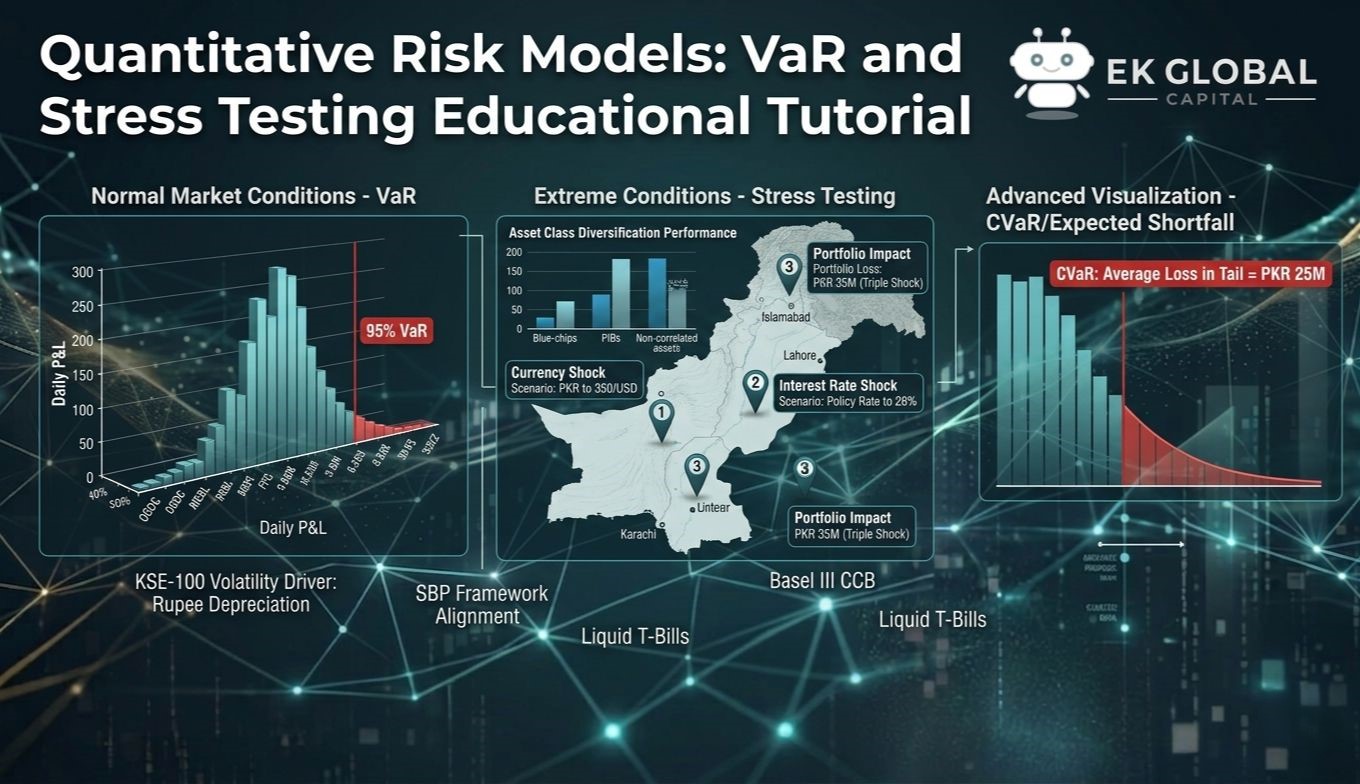
In the rapidly evolving landscape of the Pakistani financial sector, risk management has transcended traditional guesswork. With the China-Pakistan Economic Corridor (CPEC) driving infrastructure development and the Pakistan Stock Exchange (PSX) offering a diverse range of equities, including KSE-100 index heavyweights, the need for sophisticated quantitative risk models has never been more critical.
Introduction: The Pakistani Financial Frontier In the rapidly evolving landscape of the Pakistani financial sector, risk management has transcended traditional guesswork. With the China-Pakistan Economic Corridor (CPEC) driving infrastructure development and the Pakistan Stock Exchange (PSX) offering a diverse range of equities, including KSE-100 index heavyweights, the need for sophisticated quantitative risk model...
For institutional investors, fund managers, and risk officers in Karachi, Lahore, and Islamabad, understanding Value at Risk (VaR) and Stress Testing is not merely a regulatory checkbox—it is a strategic imperative. These models quantify the invisible: the potential for financial loss hidden within a portfolio of Pakistani blue-chip stocks, government securities (PIBs), or emerging market assets.
This tutorial provides a deep dive into quantitative risk management Pakistan , specifically calibrated for the unique volatilities of the Pakistani market, including the influence of rupee depreciation, political uncertainty, and the regulatory oversight of the State Bank of Pakistan (SBP) and the Securities and Exchange Commission of Pakistan (SECP).
Chapter 1: VaR Risk Models Explained What is Value at Risk (VaR)? At its core, Value at Risk (VaR) is a statistical technique that measures the maximum potential loss a portfolio could suffer over a specific time period under normal market conditions, given a certain confidence level.
If a Pakistani equity portfolio has a daily VaR of PKR 50 million at a 95% confidence level, it means there is a 5% chance that the portfolio will lose more than PKR 50 million in a single day, or conversely, a 95% confidence that losses will not exceed PKR 50 million.