Pakistan Refinery Sector: A Detailed Investor Guide for PSX
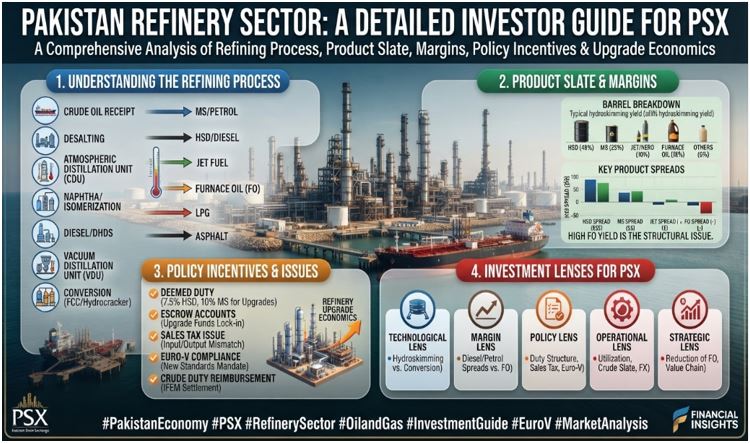
A Comprehensive Analysis of Refining Process, Product Slate, Margins, Policy Incentives, Sales Tax Issue, Euro-V Compliance and Upgrade Economics
Executive Summary Pakistan's refinery sector is strategically important but commercially complex. A refinery is not a simple plant that buys crude oil and sells petrol at a guaranteed margin. Refinery earnings are driven by the spread between the cost of crude oil and the value of the products produced from that crude. This spread is called gross refining margin, or GRM. However, GRM is not one single spread. It is...
The most important investment problem in Pakistan is that most refineries are old hydroskimming refineries. They can separate crude into different products and improve some product quality, but they have limited ability to deeply convert heavy residue and furnace oil into high-value petrol and diesel. Because all products are produced simultaneously from crude, a refinery cannot simply decide to produce only MS and...
For investors, the sector must be understood through five big lenses. First, the technological lens: whether the refinery is hydroskimming, mild-conversion or deep-conversion. Second, the margin lens: diesel and petrol spreads are usually positive, while furnace oil spreads are often negative. Third, the policy lens: deemed duty, IFEM, Euro-V compliance, escrow accounts, sales tax and crude duty reimbursement can ma...
Where Refineries Fit in Pakistan's Energy Chain Pakistan's energy chain should be divided into two separate but related flows. The first flow is the liquid petroleum chain: crude oil or condensate is produced locally or imported, transported to refineries, processed into petroleum products, and then sold through oil marketing companies. The second flow is the gas chain: natural gas is produced from gas fields, proce...